Build or Buy AI Development
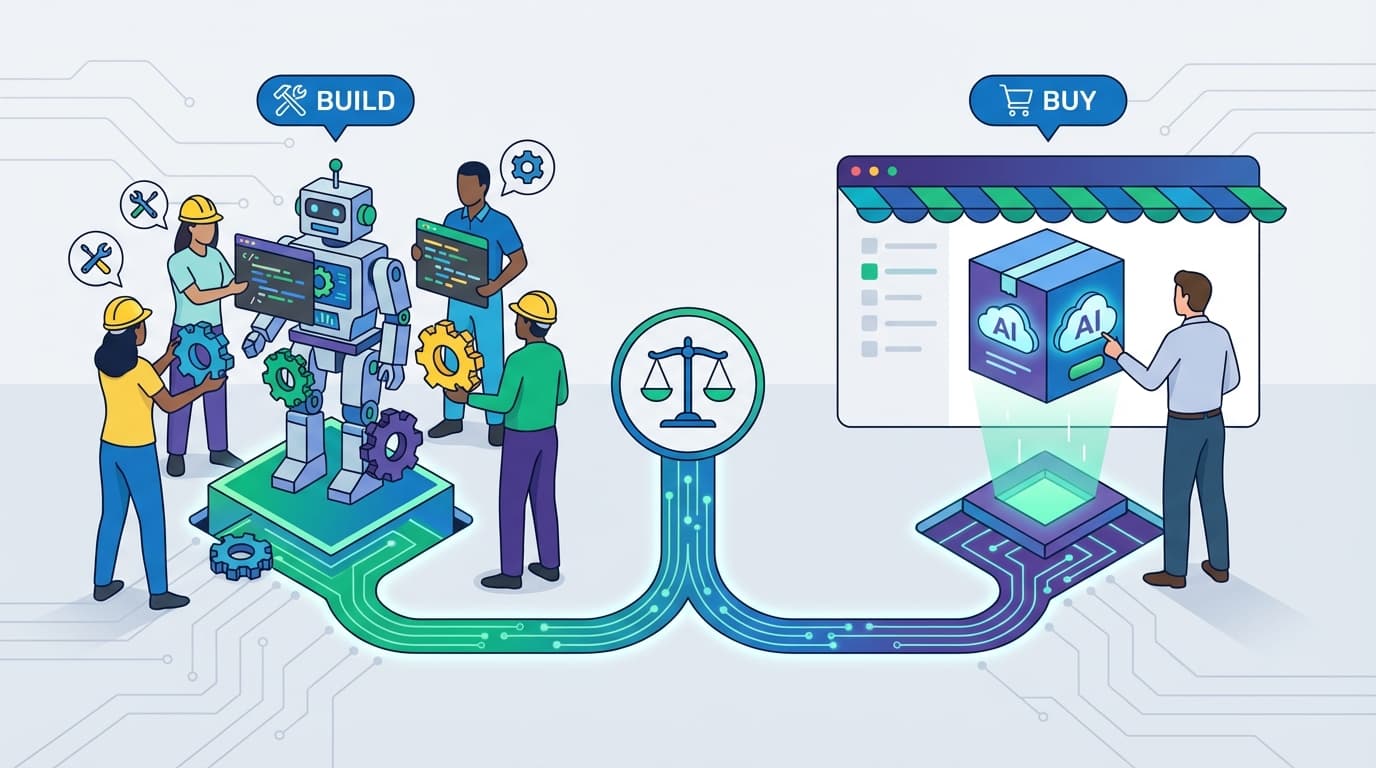
Every technology leader in 2026 faces the same question, and it's no longer about whether to adopt AI. That debate is settled. The real question is whether to build it yourself or assemble it from pre-built components. The stakes have shifted dramatically. AI systems aren't passive tools that respond to prompts anymore; they're autonomous agents that plan, reason, and execute multi-step workflows across enterprise systems. That evolution has made the build-versus-buy decision more consequential and far more nuanced than it's ever been.
The answer is rarely binary. But knowing exactly when custom development justifies its cost, and when no-code platforms deliver superior value, separates competitive advantage from wasted capital. Here's what the data tells us in 2026.
The Rise of Agentic AI Has Changed the Equation
Agentic AI: autonomous agents capable of planning and executing multi-step workflows without continuous human oversight, defines AI development in 2026. According to research from Yameo citing Gartner projections, 40% of enterprise applications will leverage task-specific AI agents by 2026. This isn't a marginal trend. It represents a fundamental shift in what both custom and no-code platforms are expected to deliver.
Read also: How Vibe Coding Is Changing Software Development in 2026
The major enterprise platforms have responded aggressively. According to Salesforce Ben, Salesforce launched "Agentforce 360" in January 2026, enabling autonomous agents to handle Tier-1 support and sales tasks without human intervention. As reported by CIO.com, ServiceNow is rolling out "AI Specialists" in Q2 2026: purpose-built agents like L1 Service Desk AI designed to replace human effort in specific operational roles. Microsoft's Power Apps platform now supports Model Context Protocol (MCP), allowing agents to interact directly with application logic and data.
What does this mean for the build-versus-buy decision? No-code platforms are no longer just form builders and workflow automators. They've become agent orchestration environments. Platforms like Microsoft Copilot Studio and Salesforce Agentforce now let business users build autonomous agents that can reason, plan, and trigger actions across systems. Capabilities that once required a team of machine learning engineers are increasingly accessible through drag-and-drop interfaces.
But accessibility doesn't mean equivalence. The gap between what a no-code agent can do and what a custom-built system can achieve remains wide in specific, high-stakes scenarios. That gap is where the real strategic decisions live.
The Cost Reality: Understanding the "U-Curve" of Expense
Cost efficiency in AI development follows what we might call a "U-curve" in 2026. No-code is cheapest for low-volume, internal applications. Custom development is cheaper at high scale. The expensive middle ground (where many companies find themselves stuck) is the transition zone between the two.
Read also: Where Is Google Gemini Headed in 2026? Full Analysis
Initial Investment vs. Long-Term Ownership
The upfront numbers tell a compelling story for no-code. According to DesignRevision's 2026 comparison, no-code and low-code AI platforms typically cost between $240 and $6,000 per year, with time-to-market measured in two to four weeks. Custom AI development, by contrast, starts at $50,000 and can exceed $500,000, with delivery timelines of three to six months.
That initial cost advantage erodes, sometimes rapidly. No-code platforms reduce initial build time by 50-80%, according to DesignRevision, yet they often become more expensive than custom solutions over a three-to-five-year period due to usage-based pricing and what amounts to ongoing "platform rent." The maintenance burden shifts too: while no-code vendors handle updates (reducing operational effort), custom development typically requires 20-30% of the annual budget for ongoing maintenance.
The "Scale Wall" Problem
The most dangerous cost dynamic is what the industry calls the "scale wall." According to research from KumoHQ, a no-code MVP might cost $500 per month, but scaling it to 100,000 users can balloon costs to $15,000 per month, often exceeding the cost of hosting a custom microservice for the same workload.
This isn't a theoretical risk. According to DesignRevision, 25-30% of no-code projects are rewritten in custom code within two years. The "rewrite trap," as experienced founders describe it, goes like this: you build on a no-code platform, hit a feature or cost ceiling, and face a total rebuild costing $50,000 to $250,000, precisely when the business is beginning to grow and can least afford the disruption.
Here's a summary of the cost dynamics based on available research:
- No-Code Initial Cost: $240–$6,000/year (low)
- Custom Initial Cost: $50K-$500K+ (high)
- No-Code Scaling Cost: High: linear or exponential with usage
- Custom Scaling Cost: Low: fixed infrastructure costs
- No-Code Hidden Costs: Platform lock-in fees, scale wall penalties
- Custom Hidden Costs: Recruiting and retaining niche talent (AI engineers commanding $200K+ salaries)
The Strategic Decision Framework: Differentiation Over Cost
In 2026, the decision to build in-house rests primarily on differentiation and data sovereignty, not just cost. The consensus among technology leaders boils down to a single principle: rent the utility, build the core. Buy or no-code the commodity AI capabilities (like customer service bots), but ruthlessly build proprietary models that drive revenue.
Read also: How Claude Code and AI Agents Are Redefining Development
When to Build Custom
Custom development makes sense when AI isn't a supporting tool but the product itself. If the AI model represents the competitive moat (think a proprietary drug discovery algorithm or a unique risk-scoring engine), then owning the model weights and training data is non-negotiable. Renting that capability from a platform means renting your competitive advantage.
Custom development is also warranted when:
- High-performance requirements exist: Applications requiring real-time inference at sub-50-millisecond latency or massive scale that no-code platforms throttle demand custom infrastructure.
- Regulatory constraints are severe: Organizations handling highly sensitive data in healthcare, finance, or defense cannot risk third-party platform data leakage.
- Long-term IP ownership matters: If the training data and model architecture represent years of accumulated institutional knowledge, owning rather than renting those assets is a strategic imperative.
When No-Code Wins
No-code and low-code platforms deliver superior value when AI serves as a utility rather than a differentiator. Standard capabilities like document processing, chatbots, and sentiment analysis that support a non-AI core business are ideal candidates.
No-code is also the right choice for:
- Internal tools: HR portals, inventory trackers, and marketing automation workflows where speed of deployment matters more than architectural elegance.
- MVP validation: Testing a hypothesis in under four weeks before committing engineering resources. No-code's two-to-four-week deployment timeline makes it ideal for rapid experimentation.
- Talent-constrained organizations: Companies that lack access to AI engineers (who command salaries of $200,000 or more) can leverage no-code platforms to close the capability gap.
The Hybrid Strategy: Why Leading Enterprises Choose Both
The dominant strategy among leading enterprises in 2026 is hybrid AI: using no-code for internal utilities and standard applications while reserving custom code for core intellectual property and high-performance models. According to Forbes, this hybrid approach has emerged as a significant industry trend.
Read also: Claude vs Gemini vs ChatGPT 2026: Strategic AI Choice
This isn't a compromise. It's an optimization. Picture a financial services firm that uses Salesforce Agentforce to handle routine customer inquiries (a commodity function) while maintaining a custom-built fraud detection model trained on proprietary transaction data (a core differentiator). The no-code layer handles the volume; the custom layer protects the moat.
The talent picture reflects this shift. According to Integrate.io, the citizen developer to professional developer ratio has reached 4:1. Yet demand for "AI Architects" (professionals who can orchestrate multi-agent systems spanning both no-code and custom components) has surged, replacing the traditional need for junior coders. The 10x engineer of 2026 isn't writing boilerplate code. They're orchestrating multi-agent systems.
Security, Compliance, and the Shadow AI Threat
The security and compliance picture in 2026 has introduced new urgency to the build-versus-buy decision. The regulatory environment has teeth, and the risks of ungoverned AI development are no longer hypothetical.
The EU AI Act: August 2026 Deadline
According to Secure Privacy, the EU AI Act's high-risk obligations become fully enforceable in August 2026. This legislation imposes strict compliance requirements on "high-risk" AI systems, including mandatory technical documentation, transparency obligations, and human oversight mechanisms.
No-code platforms present a specific challenge here. They often function as "black boxes," making it difficult to generate the technical documentation required for compliance. Organizations deploying no-code AI agents in high-risk categories (healthcare decisions, credit scoring, employment screening) may find themselves unable to demonstrate the transparency and explainability that regulators demand.
The Shadow AI Crisis
"Shadow AI" (unguarded citizen development of AI agents without organizational governance) has become a critical liability. According to research from Spektion, 60% of insider threats are now linked to personal cloud applications. Citizen developers spinning up ungoverned AI agents create security exposure that scales with the ease of the tools they use.
Agentic AI amplifies the risk. These systems operate at machine speed. A misconfigured no-code agent can hallucinate and leak thousands of sensitive records in minutes, far faster than any human error could produce equivalent damage. Companies are responding with centralized governance mechanisms, such as ServiceNow's "AI Control Tower" concept, to monitor and govern autonomous agents across the organization.
The "Vibe Coding" Vulnerability
Natural-language-to-code generation (sometimes called "vibe coding") has gone mainstream in 2026. But reliability remains a concern. Research indicates that 45% of AI-generated code contains security flaws. This applies to both no-code platforms (which increasingly rely on AI-generated logic) and custom development teams using AI coding assistants. The critical difference: custom teams can audit and remediate. No-code users often can't inspect the underlying code at all.
Vendor Lock-In: The Hidden Strategic Risk
Vendor lock-in remains one of the most underappreciated risks of no-code AI development in 2026. When an organization builds on a proprietary no-code platform, it typically owns the data but not the logic. Migrating business logic away from platforms like Bubble or Salesforce is notoriously difficult, creating a dependency that extends far beyond the initial subscription cost.
Pricing volatility compounds the risk. If a no-code vendor changes their pricing model (as has happened with other platform companies in the past), operating costs can double overnight without recourse. Organizations with mission-critical workflows running on a single vendor's platform have no negotiating leverage and no easy exit.
This is exactly why the hybrid approach offers a structural advantage: by keeping core IP on custom infrastructure and using no-code only for commodity functions, organizations limit their exposure to any single vendor's pricing decisions or platform changes.
A Practical Decision Checklist for 2026
For technology leaders evaluating the build-versus-buy decision in 2026, the following framework synthesizes the available evidence:
- Is AI your product or your tool? If AI is the product, build custom. If it supports a non-AI core business, start with no-code.
- What is your expected scale? If you anticipate high transaction volumes or large user bases, model the no-code cost curve carefully. The scale wall is real, and it hits faster than most teams expect.
- Do you operate in a regulated industry? If you deploy AI in high-risk categories under the EU AI Act, ensure your platform can produce the required technical documentation. Custom development offers more control here.
- What is your time horizon? For validation and MVPs, no-code's two-to-four-week deployment is unbeatable. For three-to-five-year strategic investments, custom development often delivers lower total cost of ownership.
- Do you have governance in place? Before enabling citizen developers with no-code AI tools, establish an AI governance framework to prevent shadow AI proliferation.
The Bottom Line
The custom-versus-no-code debate in 2026 isn't about choosing a side: it's about choosing correctly for each use case. No-code platforms have evolved into powerful agent orchestration environments capable of delivering genuine business value in weeks rather than months. But they carry real risks at scale: cost escalation, vendor lock-in, compliance gaps, and security vulnerabilities that compound as autonomous agents operate at machine speed.
Custom development remains essential for organizations whose AI capabilities represent core intellectual property, require high-performance infrastructure, or must meet stringent regulatory requirements. The upfront investment is significant, but the long-term economics and strategic control often justify it.
The winning strategy in 2026 is hybrid: rent the utility, build the core. Use no-code to move fast on commodity functions. Invest custom engineering resources where AI creates genuine competitive differentiation. And above all, govern everything. Because in the age of agentic AI, an ungoverned agent isn't just a technical risk. It's a business liability.
Need AI-powered automation for your business?
We build custom solutions that save time and reduce costs.
About the Author
Jiri Zmidloch
Founder of Process Gate AI. Building intelligent automation solutions, AI-powered SaaS products, and custom solutions that solve real-world problems. Based in Brno, Czech Republic.