Where Is Google Gemini Headed in 2026? Full Analysis
Google's Gemini started life as a generative AI chatbot. It has since become something far more ambitious: a comprehensive operating layer that's reshaping how people interact with every Google service. As of February 2026, the Gemini ecosystem spans flagship reasoning models, autonomous browser agents, system-level Android integration, and a Workspace intelligence layer connecting Gmail, Drive, Calendar, and YouTube into a single context. The question is no longer whether Gemini will be deeply woven into Google's services. It already is. The real question: how far will Google push this integration by the end of 2026, and what do the unverified rumors and roadmap leaks tell us about the company's ultimate vision?
This article maps the current state of Gemini, its confirmed integrations across Google's product suite, and the predictions (some substantiated, some purely speculative) about where the technology is heading in the months ahead.
The Current Gemini Model Landscape in February 2026
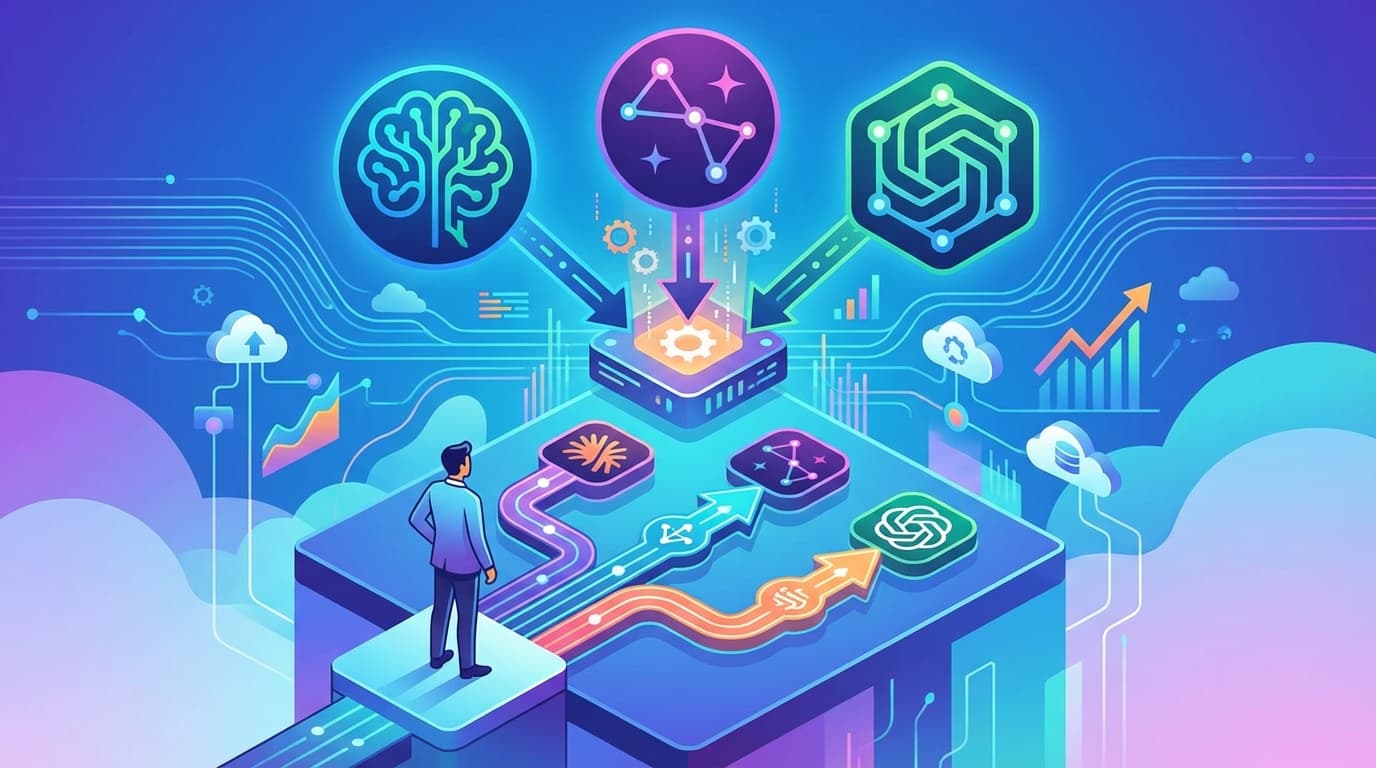
Google's Gemini model strategy as of February 2026 follows a multi-tier architecture built to balance raw intelligence with cost efficiency. The newest model, Gemini 3.1 Pro, dropped on February 19, 2026, and represents the cutting edge of Google's reasoning capabilities, according to the Wikipedia entry on Gemini (language model). Meanwhile, Gemini 2.0 Flash continues doing the heavy lifting for standard, high-frequency applications.
Read also: Claude Code + n8n Automation: 3 GSD Framework Wins
Gemini 3.1 Pro and "Deep Think" Reasoning
Gemini 3.1 Pro is built around what Google calls "Deep Think" reasoning: a capability aimed at PhD-level problem-solving and complex multi-step analysis. According to the State of Gemini AI: 2026 Progress Report, this model powers the "Deep Research" feature, which can autonomously browse, read, and synthesize dozens of documents to generate comprehensive reports. A massive context window lets it process and cross-reference large volumes of information in a single session.
What does this mean in practice? For enterprise users and knowledge workers, Gemini now functions less like a chatbot and more like a research analyst. One that reads everything, forgets nothing within its context window, and produces structured output on demand.
Gemini 2.0 Flash: The Cost-Efficient Backbone
Not every task needs PhD-level reasoning. Released in early 2025, the Gemini 2.0 Flash and Flash-Lite models remain the backbone for high-frequency, low-latency tasks, according to TechTarget's coverage of the Gemini 2.0 release. They handle real-time translation, smart home commands, and other rapid-response interactions where speed and cost-efficiency matter more than deep analytical power.
This tiered approach is key to understanding Google's strategy. Gemini isn't a single model. It's an ecosystem of models deployed at different price and performance points across billions of daily interactions.
Multimodal File Understanding
One of the most significant capabilities in the current Gemini models is what Google calls "Multimodal File Understanding." According to reporting on the Connected Apps and Multimodal updates, users can upload PDFs, videos, and spreadsheets simultaneously, and Gemini can cross-reference all of them. Picture a product team uploading a video demo alongside a spreadsheet of customer feedback. Gemini synthesizes both into a strategy document. This isn't theoretical anymore. It's a live feature in the current model family.
How Deeply Is Gemini Integrated into Google Services?
Gemini is no longer an add-on or optional feature within Google's ecosystem. As of 2026, it functions as core infrastructure across Android, Google Workspace, and Chrome. The depth of this integration is unprecedented for a consumer-facing AI system.
Read also: Build AI Agents with Claude and n8n in 2026
Android 16: Gemini Replaces Google Assistant
Android 16, released in mid-2025, marked a decisive turning point. According to Android Faithful's coverage of Android 16 features, this OS version replaced the traditional Google Assistant with Gemini for most users. The integration goes well beyond voice commands. Key features include:
- Gemini-powered Notification Summaries: Instead of showing every alert, Gemini filters noise and presents summarized, prioritized notifications.
- Real-time Scam Detection: Gemini analyzes calls and messages in real time, flagging potential scams before users engage with them.
These aren't experimental features buried in a settings menu. They're system-level capabilities affecting how hundreds of millions of Android users interact with their phones every day.
Android 17 Beta: Screen Automation
The next frontier is already in testing. According to reporting from Sammy Fans on the Android 17 roadmap, the Beta 1 release (available as of February 2026) introduces "Screen Automation." This feature lets Gemini "see" the user's screen and perform physical actions: tapping buttons, scrolling through interfaces, navigating apps on the user's behalf.
The practical implication is striking. A user could say "Order my usual from Uber Eats," and Gemini would physically navigate the Uber Eats app, select the items, and complete the order. This is fundamentally different from API-based integrations. Gemini interacts with apps the same way a human would: by looking at the screen and tapping.
For businesses building on Android, this raises thorny questions about app design, user experience, and whether AI agents will become the primary "users" of mobile applications.
Google Workspace: The "Connected Apps" Intelligence Layer
In late 2025, Google rolled out the "Connected Apps" update for Workspace, according to reporting on the Gemini 2026 updates. This update linked Gmail, Drive, Calendar, and YouTube into a single unified context that Gemini can access simultaneously. Users can now issue compound commands like: "Find the Drive doc about the Q1 budget, summarize it, and draft an email to the team based on those figures."
That's a significant leap from earlier Workspace AI features, which operated within individual apps. The connected context means Gemini understands the relationships between a user's emails, documents, calendar events, and even YouTube content, and can act across all of them in a single workflow.
There's more. A "Studio" tab in Gmail now lets users build simple automation workflows without coding. According to the same reporting, users can create rules like "If an email comes from Client X, draft a reply using Template Y and add a task to Trello." This positions Gemini not just as a conversational assistant but as a lightweight workflow automation engine: a space that directly intersects with dedicated process automation platforms.
Chrome and Project Jarvis: The Web Agent
Project Jarvis, Google's Chrome-based AI agent, has one of the more colorful origin stories in recent tech history. According to TechRadar's reporting, the project was accidentally leaked in November 2024 before Google intended to announce it. As of 2026, Jarvis is a live feature: a Chrome companion that automates web-based tasks.
Jarvis handles what Google describes as "mundane, tedious tasks": comparing flight prices across multiple tabs, filling out online forms, purchasing groceries by controlling the browser cursor. The agent works by observing the browser interface and taking actions, similar to how Android 17's Screen Automation works on mobile.
For anyone who spends hours on repetitive web tasks (procurement, research, booking, data entry), Jarvis represents a fundamental shift in how browser-based work gets done.
Project Astra: Gemini's Multimodal Eyes
Project Astra is Google's initiative to give Gemini the ability to see and understand the physical world through a device's camera. Originally teased in 2024, Astra's multimodal capabilities rolled out to Pixel phones in March 2025 as part of Gemini Live, according to the Wikipedia entry on Gemini and Glass Almanac's coverage of Project Astra.
Read also: How Vibe Coding Is Changing Software Development in 2026
In practice, a user can point their phone's camera at an object, a document, or a scene, and Gemini analyzes what it sees in real time: identifying objects, reading text, providing contextual information, answering questions about the visual input. This "see and understand" capability transforms Gemini from a text-and-voice assistant into something closer to a perceptual AI that interacts with the physical environment.
The implications for field workers, technicians, educators, and anyone needing hands-free AI assistance in physical spaces are substantial.
Predictions and Rumors for the Rest of 2026
Beyond what's confirmed and live today, a number of predictions and unverified rumors point to where Google may take Gemini by year's end. These should be treated as speculative, but they come from industry insiders and roadmap leaks that have historically proven directionally accurate.
Read also: Anthropic CEO: 'We Don't Know if AI Models Are Conscious'
Gemini 4: Quantum-Enhanced Training
According to predictions compiled by Dejan AI and Julian Goldie's analysis of the Gemini 4 roadmap, a Gemini 4 release is expected in Q4 2026. The most provocative rumor? Gemini 4 will integrate quantum-computing enhanced training, leveraging Google's TPU infrastructure and its Quantum AI research division to solve scientific problems that exceed the limits of classical AI training methods.
Another rumored feature is "Persistent Long-Term Memory": the ability for Gemini to remember user preferences and past projects indefinitely across all Google services. If implemented, Gemini wouldn't just respond to individual queries. It would build an evolving understanding of each user over time, fundamentally changing the nature of the human-AI relationship within Google's ecosystem.
These predictions remain unverified, but they align with Google's publicly stated research directions in both quantum computing and personalized AI.
Agentic Search as the Default Google Experience
Perhaps the most disruptive prediction for 2026 concerns Google Search itself. According to Dejan AI's analysis of Google's trajectory, Search is predicted to transition from the traditional "10 blue links" format to an "Agentic Mode" by default. In this model, instead of showing a recipe website, Google Search would offer to "Add ingredients to your cart" or "Schedule a cooking time."
This would be the most significant change to Google Search since its inception. The AI wouldn't just find information. It would act on it, completing tasks that currently require users to click through to websites and perform actions manually. The implications for web publishers, e-commerce businesses, and the entire digital marketing ecosystem are enormous.
Hardware: AI Glasses and Project Astra Native Devices
On the hardware front, rumors suggest Google may return to smart glasses in late 2026, according to Glass Almanac's reporting. These would serve as native hardware for Project Astra, giving users access to Gemini's multimodal visual capabilities hands-free. Details are scarce, but the concept aligns with the broader trajectory of moving Gemini from screens into the physical world.
Expert Sentiment: From "Wow Factor" to Utility
The expert consensus in early 2026 reflects a maturing relationship with AI. According to the State of Gemini AI: 2026 Progress Report, the industry is experiencing a shift from novelty to utility. The report notes: "We are moving away from the novelty of 'chatting with a machine' toward a utilitarian relationship where the AI acts as a partner."
This shift matters for businesses evaluating AI adoption. The question is no longer "Can AI do something impressive?" but "Can AI reliably do something useful, repeatedly, at scale?"
The answer to that second question isn't yet an unqualified yes. Despite the advancements, the developer and user community continues to report hallucinations on complex tasks and latency spikes with the newest Gemini 3.0 models, according to community feedback tracked in the 2026 Progress Report. A "reliability gap" persists: a zone where businesses hesitate to fully automate customer-facing workflows because the AI's accuracy isn't yet consistent enough for high-stakes interactions.
Risks and Limitations to Watch
The rapid expansion of Gemini's capabilities introduces new categories of risk that businesses and IT leaders need to monitor carefully.
The "Shadow Agents" Problem
A growing security concern in 2026 is what's being called "Shadow Agents": unauthorized AI agents deployed by employees who use Gemini's automation capabilities to streamline their own workflows without IT oversight. According to reporting on this emerging risk, these agents may inadvertently leak corporate data or execute risky actions because they operate outside established governance frameworks.
This mirrors the "Shadow IT" problem of previous decades, but the stakes are higher. An AI agent that autonomously browses the web, fills out forms, and sends emails on behalf of an employee can cause damage at machine speed.
The Cost of Intelligence
While Flash models remain cost-efficient, the most capable tiers (like Gemini 3.1 Pro) are expensive for heavy API usage. According to the 2026 Progress Report, a rumored "Google AI Ultra" subscription tier at $249.99 per month for enterprise power users has raised concerns about a "digital divide" in access to the most intelligent models. Organizations with deep pockets would get fundamentally different AI capabilities than smaller businesses or individual users.
SEO and Publisher Anxiety
The prediction of Agentic Search becoming the default Google experience has the digital marketing industry on edge, according to Dejan AI's analysis. If Google's AI increasingly answers queries directly or performs transactions on behalf of users, it could bypass websites entirely, effectively cutting off traffic to content publishers and e-commerce sites that depend on organic search visibility.
What This Means for Business Process Automation
Gemini's trajectory has direct implications for how organizations think about workflow automation and enterprise productivity. The convergence of multimodal understanding, cross-service context (via Connected Apps), and agentic capabilities (via Jarvis and Screen Automation) means Google is building an automation layer that operates at the operating system level.
For businesses already investing in process automation, several considerations stand out:
- Complementary, not competing: Gemini's Workspace Studio feature enables lightweight automations, but complex, multi-system enterprise workflows still require dedicated orchestration platforms offering governance, audit trails, and cross-platform integration beyond Google's ecosystem.
- Governance is non-negotiable: The Shadow Agents risk underscores the need for centralized AI governance. Organizations need clear policies about which AI agents can operate, what data they can access, and what actions they can take autonomously.
- The reliability gap matters: Until the hallucination and latency issues are resolved, mission-critical business processes need human-in-the-loop safeguards: something purpose-built automation platforms are designed to provide.
Looking Ahead: The Shape of 2026
Google Gemini in 2026 is no longer a product. It's an infrastructure layer that touches search, mobile, productivity, and the web browser. The confirmed integrations across Android 16, Workspace Connected Apps, and Chrome (via Project Jarvis) are already reshaping daily workflows for millions of users. The unverified predictions (Gemini 4 with quantum-enhanced training, Agentic Search as the default, AI glasses) suggest Google's ambitions reach even further.
The shift from chatting to acting, from answering questions to completing tasks, represents a fundamental change in what AI means for businesses and individuals alike. Whether Google can close the reliability gap and address the emerging security concerns will determine how quickly organizations move from cautious experimentation to full-scale adoption.
One thing is clear: Gemini is not a feature Google is adding to its services. It is becoming the service itself.
Need AI-powered automation for your business?
We build custom solutions that save time and reduce costs.
About the Author
Jiri Zmidloch
Founder of Process Gate AI. Building intelligent automation solutions, AI-powered SaaS products, and custom solutions that solve real-world problems. Based in Brno, Czech Republic.