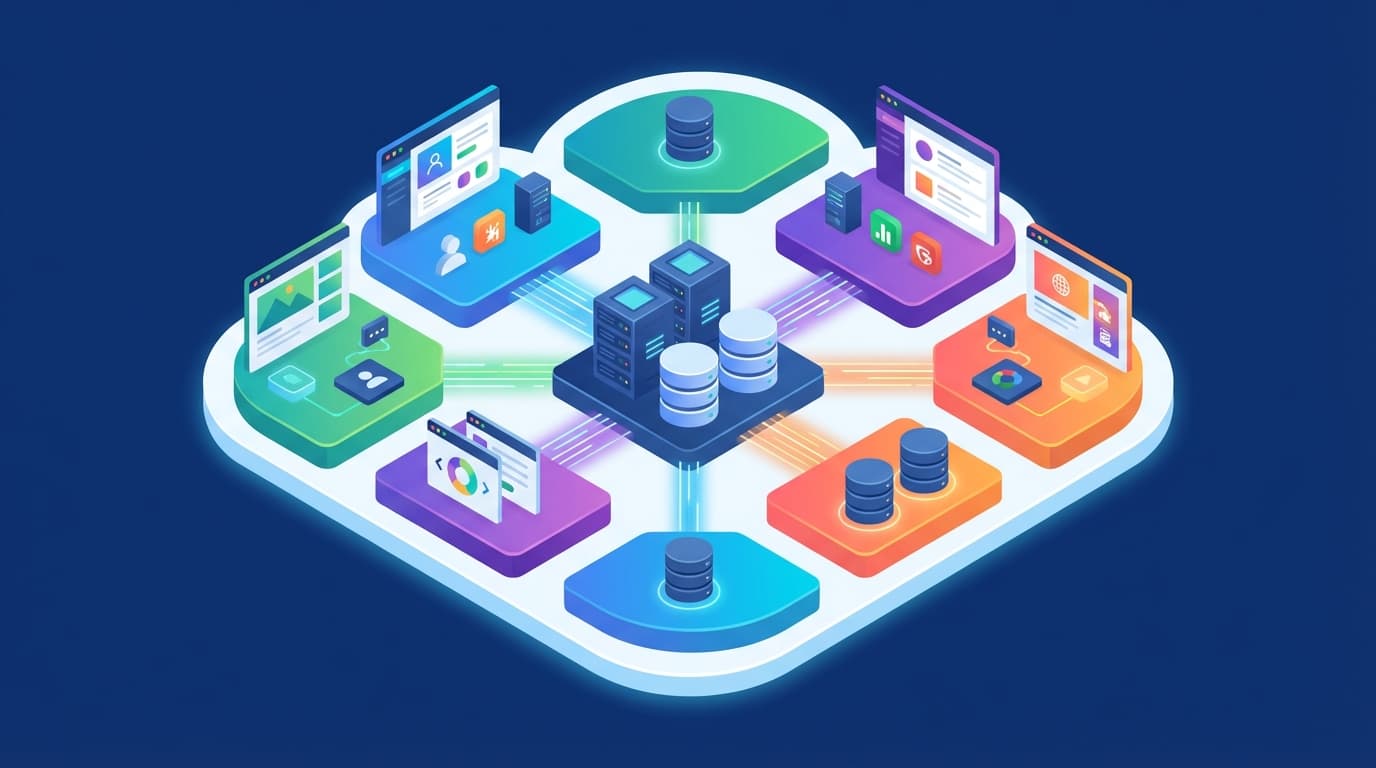
Multi-Tenant SaaS Architecture Patterns
Your multi-tenant architecture worked fine at 500 tenants. At 5,000, cracks started showing. At 10,000? The architectural decisions you made at launch can become existential threats to performance, security, and reliability. That's the reality of multi-tenant SaaS: a single software instance serving multiple customers (tenants) while keeping their data and configurations logically separated. It's the backbone of modern SaaS, and it breaks in predictable ways when you don't plan for scale.
The consensus among practitioners in 2025 is clear: there is no single "best" multi-tenant pattern. The right choice depends on your business model, your target customer, and your scale. What has changed is the sophistication of the patterns available and the maturity of the tooling behind them. This article breaks down seven architecture patterns defining how SaaS platforms scale in 2025, from foundational database strategies to cutting-edge network security approaches.
Pattern 1: Database per Tenant (The Silo Model)
The Silo model gives you the highest level of data isolation by provisioning a completely independent database instance for each tenant. For B2B SaaS products serving enterprise clients with stringent security, compliance, and data governance requirements, this is the gold standard.
Read also: Vertical SaaS Reshapes Software
A dedicated database per tenant means maximum security and the lowest risk of data leakage between tenants. You can manage backups, restores, and data versioning on a per-tenant basis. Compliance audits become simpler because each tenant's resources are fully dedicated and clearly delineated.
Trade-offs
- Strongest Isolation: Each tenant's data lives in its own database, making cross-tenant data leakage virtually impossible at the infrastructure level.
- Per-Tenant Customization: Individual tenant requirements, such as specific backup schedules and custom data retention policies, are straightforward to implement.
- High Cost: Infrastructure costs increase proportionally with the number of tenants, making this model expensive for a large tenant base.
- Operational Overhead: Schema migrations and software updates must be applied to every single database, which dramatically increases operational complexity.
The Silo model is ideal for enterprise-tier customers in regulated industries or those who pay a premium for dedicated resources. It is not a viable default for platforms expecting thousands of small tenants.
Pattern 2: Schema per Tenant (The Bridge Model)
The Bridge model uses a single database instance but creates a separate schema for each tenant within it. Think of it as a middle ground between the complete isolation of the Silo model and the complete sharing of the Pool model.
Read also: Shannon AI Pentester Explained
This pattern maintains a degree of logical data isolation while sharing more expensive infrastructure resources like the database server itself. It works well for SaaS applications with a moderate number of tenants (generally in the range of hundreds to a thousand) that need a balance between isolation and cost-efficiency.
Trade-offs
- Balanced Approach: Tenants get their own logical namespace within a shared database, providing meaningful isolation without the cost of dedicated instances.
- Management Complexity: Managing a large number of schemas can become unwieldy as the tenant base grows, particularly during migrations.
The Bridge model fits mid-market SaaS products where tenants need more isolation than a shared table but don't justify the cost of a fully dedicated database.
Pattern 3: Shared Database, Shared Schema (The Pool Model)
The Pool model is the most cost-effective multi-tenant pattern, full stop. All tenants share a single database and a single set of tables, with data for each tenant distinguished by a tenant_id column on every relevant table. B2C applications and the free and low-cost tiers of B2B SaaS products commonly use this approach.
Read also: Build or Buy AI Development
The primary advantage? Maximum infrastructure efficiency and resource utilization, leading to the lowest cost per tenant. Database migrations and updates only need to happen once on the single database, which dramatically simplifies operations.
The Critical Risk: Data Leakage
But the Pool model carries a serious risk. A single implementation error in the application code, such as forgetting a WHERE tenant_id = ? clause in one SQL query, could expose one tenant's data to another. This is the primary danger of any shared-infrastructure model.
To mitigate this, PostgreSQL's Row Level Security (RLS) has become the standard practice in 2025 for SaaS applications using the Pool pattern. RLS enforces tenant data isolation directly at the database layer. Even if application code contains a bug that omits the tenant filter, the database itself prevents cross-tenant data access. This defense-in-depth approach significantly reduces the risk of application-level bugs causing data leakage, though it is not foolproof.
The Noisy Neighbor Problem
The other significant concern with the Pool model is the noisy neighbor problem. A single tenant running a heavy query or process can degrade performance for every other tenant sharing the database. Managing this effectively requires sophisticated monitoring and rate-limiting.
Pattern 4: The Hybrid Model: The Dominant Approach in 2025
If there's one pattern that defines multi-tenant SaaS in 2025, it's the Hybrid model. It combines the Pool and Silo models, allowing a SaaS provider to offer tiered services: smaller customers land in a cost-effective shared pool, while larger enterprise customers get migrated to dedicated, siloed infrastructure as their needs and revenue grow.
Read also: Gemini Rebuilds Google Workspace
This "start in the pool, graduate to a silo" growth path is a frequently recommended strategy among SaaS practitioners. Most successful platforms evolve their architecture over time. They begin with a simple, cost-effective Pool model to achieve product-market fit, then selectively migrate high-value customers to a Hybrid or Silo model as revenue grows.
Why It Works
- Flexible Pricing: Directly enables tiered pricing plans based on the level of isolation and performance provided to each tenant.
- Scalable Investment: Infrastructure expands and segments as the business grows, aligning costs with revenue rather than front-loading expensive dedicated resources.
- Risk Diversification: A failure or performance issue in one part of the infrastructure (say, a shared pool) doesn't affect tenants on dedicated infrastructure.
The Challenges
- Implementation Complexity: You need sophisticated tenant routing logic at the application layer to dynamically switch database connections based on the tenant's tier.
- Operational Overhead: The operations team must manage multiple database strategies in parallel, demanding a mature DevOps practice.
- Migration Risk: Moving a tenant from one model to another (Pool to Silo, for example) is a complex and risky operation that requires careful planning to avoid downtime or data loss.
The Hybrid model is the dominant choice for most mature B2B SaaS companies serving a mix of small, mid-market, and enterprise customers.
Pattern 5: Cell-Based Architecture for Massive Scale
Cell-based architecture is built for SaaS platforms with a very large number of tenants (10,000 and beyond). This approach gained prominence at events like AWS re:Invent 2024 and represents the cutting edge of multi-tenant design for ultra-large-scale platforms.
Here's how it works: tenants are grouped into "cells," which are fully independent, self-contained deployments of the entire application stack. A global routing layer directs traffic to the correct cell for a given tenant. Each cell is essentially a miniature version of your entire platform, running autonomously.
Why Cells Matter at Scale
- Fault Isolation: A failure in one cell does not cascade to other cells, minimizing the "blast radius" of an outage. When you're serving tens of thousands of tenants, even brief downtime affects massive numbers of users. Containment is everything.
- Noisy Neighbor Mitigation: The impact of a high-load tenant stays confined to their specific cell, protecting the performance of the overall system.
- Phased Deployments: You can run canary releases and other phased rollout strategies by deploying new features to a single cell first, validating them in production before a wider rollout.
That said, this architecture is over-engineering for early-stage companies. It's best suited for ultra-large-scale SaaS platforms (think Slack or Notion scale) that need to ensure high availability and performance across a global user base.
Pattern 6: Zero Trust Architecture with Mutual TLS (mTLS)
Zero Trust has become foundational for secure multi-tenant architecture in 2025. The principle is simple: "never trust, always verify." Every request, regardless of whether it originates from inside or outside the network, is treated as potentially malicious.
A key implementation of Zero Trust in multi-tenant SaaS is Mutual TLS (mTLS). Standard TLS only requires the server to prove its identity to the client. mTLS goes further by requiring both the client and the server to present and validate digital certificates. This provides strong, cryptographic proof of identity for every service-to-service connection, not just for the client connecting to the edge.
Why This Matters for Multi-Tenancy
In a multi-tenant environment, dozens or hundreds of microservices communicate with each other internally. Without mTLS, an attacker who gains access to the internal network could move laterally, communicating with other services and potentially accessing tenant data. With mTLS, every service must present a valid certificate before any communication occurs. That's a powerful layer of defense-in-depth deep within the network.
mTLS is often managed by a service mesh or modern networking tools that automate certificate issuance, rotation, and validation, reducing the operational burden on engineering teams.
Tenant Identification via JWT
Complementing Zero Trust at the application layer, embedding tenant information (such as an org_id) directly within JWT (JSON Web Token) claims is a mainstream approach for tenant resolution in 2025. This method is stateless, tamper-proof, and completes tenant identification simultaneously with user authentication. No separate tenant-lookup step on every request. Clean and efficient.
Pattern 7: eBPF and Cilium for Scalable Network Security
Modern multi-tenant systems running on Kubernetes are moving away from traditional iptables-based networking for security enforcement. The reason is straightforward: as the number of microservices and tenants grows, the number of firewall rules in iptables can explode, leading to significant performance degradation. eBPF and Cilium represent the modern alternative.
eBPF (extended Berkeley Packet Filter) is a Linux kernel technology that allows running sandboxed programs directly in the kernel. Cilium is a networking, observability, and security tool built on eBPF. Together, they enable a fundamentally different approach to network security in multi-tenant environments.
How It Works
Instead of relying on IP addresses, which change frequently in cloud-native environments, Cilium assigns a cryptographic identity to each workload, such as a pod or microservice. Security policies are then written based on these stable identities. A policy might state: "Tenant A's API service can communicate with Tenant A's database service," without referencing any specific IP address.
Key Benefits
- Scalable Performance: eBPF performance remains linear regardless of the number of rules, avoiding the bottlenecks that plague
iptablesat scale. - Identity-Based Security: Policies are more robust and easier to manage because they aren't tied to ephemeral IP addresses.
- Application-Layer Control: Cilium can inspect and enforce policies on Layer 7 protocols like HTTP and gRPC, allowing for business-logic-aware security at the network layer.
The Learning Curve
This pattern requires specialized expertise in eBPF, and debugging issues at the kernel level can be more challenging than traditional userspace troubleshooting. For teams without this expertise, the adoption curve is steep, but the scalability benefits at 10,000+ tenants make it a worthwhile investment.
Choosing the Right Pattern: A Decision Framework
These seven patterns are not mutually exclusive. In practice, a mature SaaS platform in 2025 will combine several of them. A platform might use the Hybrid model for its database strategy, deploy within a Cell-based architecture for fault isolation, enforce Row Level Security on its shared databases, use JWT-based tenant identification for every request, implement mTLS for all service-to-service communication, and rely on eBPF/Cilium for network policy enforcement.
The key considerations when choosing your combination:
- Your customer profile: Enterprise B2B customers demand Silo-level isolation. High-volume B2C or SMB customers are better served by Pool models with strong RLS enforcement.
- Your scale trajectory: If you're targeting 10,000+ tenants, invest early in Cell-based architecture and eBPF-based networking. If you're pre-product-market-fit, start with the Pool model and plan your migration path.
- Your security posture: The community emphasizes a defense-in-depth approach in 2025, combining network-layer controls like eBPF, identity-based access via Zero Trust and mTLS, and database-level enforcement via RLS to ensure tenant data is never compromised.
- Your operational maturity: More sophisticated architectures like Hybrid and Cell-based models require mature DevOps practices and extensive automation. Without them, the operational burden can outweigh the architectural benefits.
Multi-tenant architecture in 2025 comes down to a series of deliberate trade-offs between isolation, cost, and operational complexity. The platforms that scale successfully beyond 10,000 users are the ones that choose their patterns intentionally, layer their security defenses, and build the operational muscle to evolve their architecture as their business grows.
Need AI-powered automation for your business?
We build custom solutions that save time and reduce costs.
About the Author
Jiri Zmidloch
Founder of Process Gate AI. Building intelligent automation solutions, AI-powered SaaS products, and custom solutions that solve real-world problems. Based in Brno, Czech Republic.